CAESAR II vs AutoPIPE vs PASS/START-PROF - Full 2026 Comparison
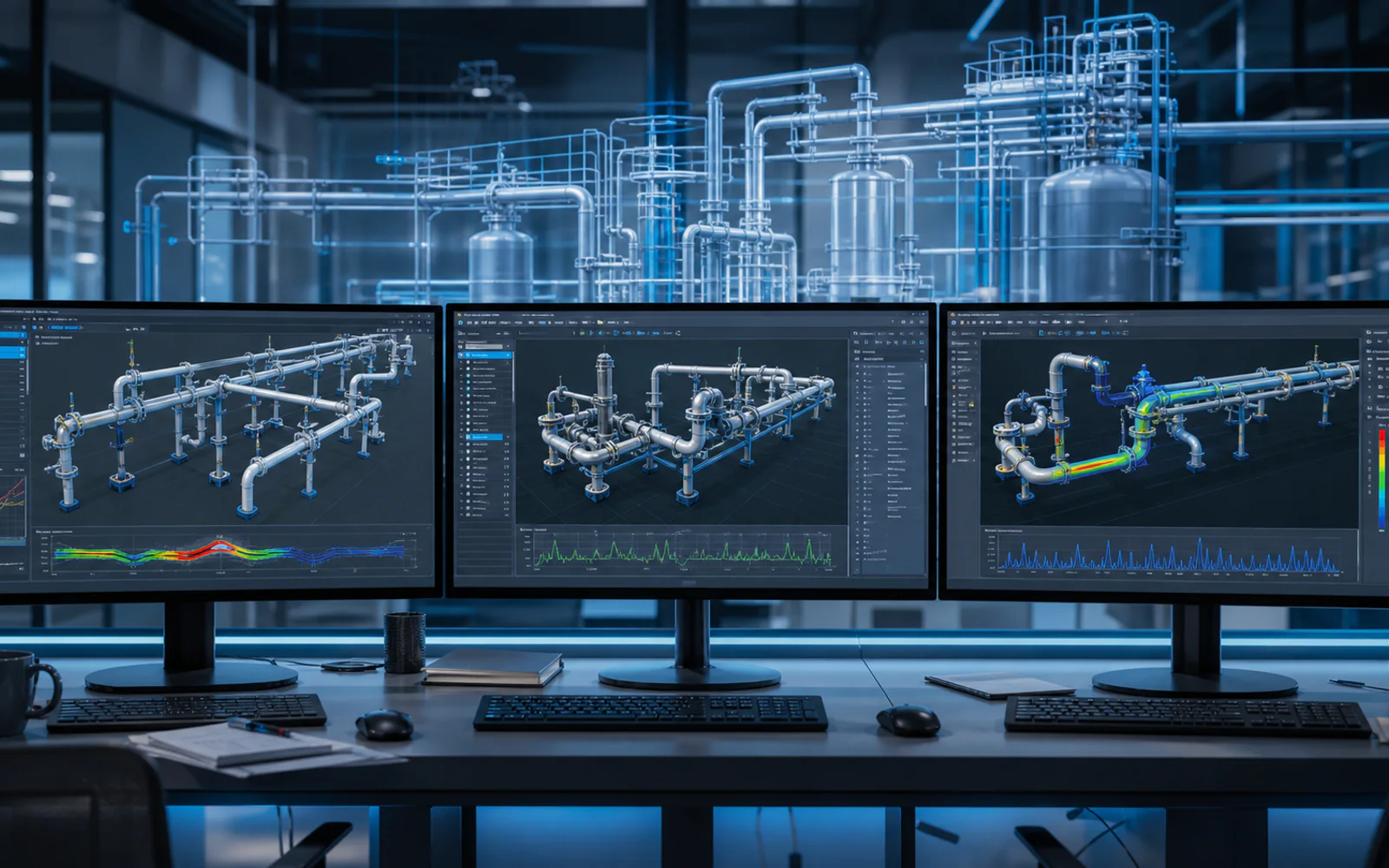
Ask three stress engineers which software is best and you will get three confident, contradictory answers. The honest comparison is about fit: CAESAR II (Hexagon), AutoPIPE (Bentley) and PASS/START-PROF (PASS Suite) all pass the same benchmark problems - they differ in workflow philosophy, code breadth, dynamics, integration and cost.
CAESAR II remains the de-facto industry standard, especially in oil & gas. Its element-by-element input model gives the analyst complete control, its B31 code implementations are the reference most owners audit against, and virtually every EPC and reviewer worldwide can open a CAESAR II file. The trade-offs are a dated interface, per-seat cost, and a workflow that rewards experience more than it helps beginners.
“The three major pipe stress packages compared honestly in 2026: modeling philosophy, code coverage, dynamic capability, reporting, licensing cost and where each one actually wins.”
AutoPIPE competes hardest on modeling speed and structural integration. Its CAD-like graphical editing is faster for large models, its coupling with STAAD lets pipe and rack interact in ways CAESAR II approximates manually, and its nuclear module (AutoPIPE Nuclear) is the standard in that niche. Where it loses: reviewer familiarity outside its strongholds, and file interchange - many owners will still ask you to convert deliverables.
PASS/START-PROF is the value disruptor. It automates more of the code compliance workflow than either rival (automatic load case generation, built-in spring selection, very strong EN 13480 and GOST coverage), its interface is the friendliest of the three, and licensing costs meaningfully less. Its limitation is ecosystem: fewer third-party reviewers know it, and some US owner specifications still name CAESAR II explicitly.
Dynamics separates serious work from checkbox work in all three: CAESAR II and AutoPIPE both offer mature response-spectrum, harmonic and time-history solvers; START-PROF covers spectrum and harmonic well but with a smaller track record on complex transient work. If your scope includes surge, slug flow or seismic time-history, weight reviewer expectations as heavily as solver capability.
Our recommendation matrix is simple. Owner specification names a tool? Use it - compliance beats preference. International O&G with third-party review? CAESAR II. Integrated pipe-plus-structure or nuclear? AutoPIPE. Cost-sensitive industrial work to EN codes? START-PROF earns its keep. Fluxiss runs CAESAR II as standard and delivers verified conversions when a client's ecosystem demands another format - the engineering judgment behind the model matters more than the logo on the license.
Syed Nasir contributes pipe stress analysis insights to the Fluxiss content library.
Related articles.
Let's Build Something Great Together.
Partner with Fluxiss for engineering that holds up - under pressure, under load, under scrutiny.