Structures · Environment · Integrity

Offshore structural engineering.

Understand the loads. Assess the details. Make informed decisions about offshore structures throughout their operating life.

Read the engineering guides
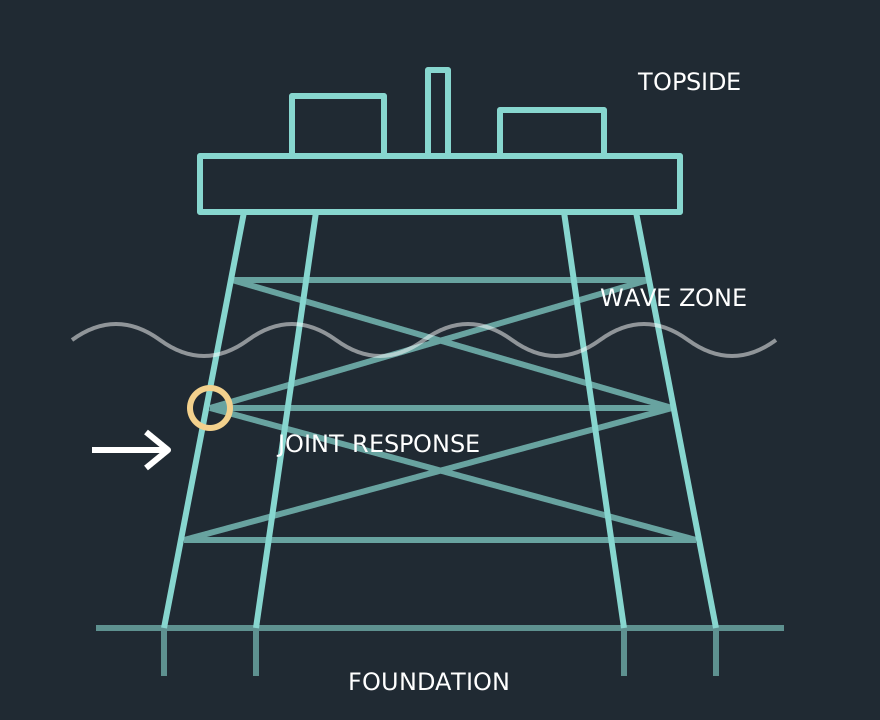
TOPSIDEWAVE ZONEJOINT RESPONSEFOUNDATION
Conceptual jacket load path and assessment interfaces

One structure. Several connected engineering questions.

Offshore assessments bring structural analysis, hydrodynamics, fatigue, inspection and foundation behaviour together. A useful result connects those disciplines to a clear decision: a new design, an equipment modification, an integrity assessment or a proposed extension of operating life. Fluxiss can help define the scope around the structure and the evidence available.

01

Jacket design & global response

Start with geometry, topside weight, environmental actions and pile restraint. A global model establishes the load path and member response; connection, fatigue and stability checks complete the assessment. Reconcile the model with the intended installation and operating states.

Seven jacket assessment problems
02

Wave, wind & current loads

Use a site-specific metocean basis, including direction, water level, current profile and marine growth. Select hydrodynamic methods appropriate to the structure's scale and motion. Keep extreme loading and long-term fatigue exposure distinct, and retain a traceable load-transfer calculation.

Follow the wave-load calculation workflow
03

Fatigue & tubular joints

Repeated environmental loading creates stress ranges at welded details. Review the global response, chord and brace geometry, stress concentration method and fatigue curve together. Local FEA may be needed where a connection cannot be represented adequately by a nominal beam intersection.

Understand offshore jacket fatigue
04

Corrosion & residual capacity

Link inspection readings to actual members and joint locations. Uniform thinning, pits and local damage do not have identical effects on strength or buckling. Separate measured condition, future-loss assumptions and protection measures before selecting a repair or reassessment strategy.

Assess the structural effect of steel loss
05

Vessel impact & damaged structures

Define the accidental scenario, impact location and required performance with the project team. Characterise dents, missing members and connection damage before assessing residual capacity. Local impact behaviour and the remaining global load path need compatible assumptions.

Explore structural assessment services
06

Global and local offshore FEA

Use global models for system response and local models for stress gradients, joints and load-introduction regions. Check transferred forces or displacements, boundary placement and mesh convergence. Choose acceptance quantities that match the failure mode instead of relying on a contour maximum.

Explore finite element analysis
Assessing an existing offshore platform

Begin with the as-is geometry, weight register, load history and inspection findings. Compare those inputs with the original design basis and the proposed future operation. The assessment should identify critical members and joints, conditional assumptions, further inspection needs and the engineering basis for any repair or operating restriction.

An asset's age alone does not determine residual strength. Deterioration, damage and undocumented changes must be connected to the actual load path. Strengthening also needs assessment of installation stages and the altered stiffness or fatigue detail.

Read the existing-structure assessment workflow

What to share for a scope review

  • Structural and as-built drawings, member schedules and connection details.
  • Site metocean data, foundation information and the adopted design basis.
  • Topside weights, equipment reactions and proposed modifications.
  • Inspection reports, thickness readings and damage or repair records.
  • Operating history, intended future use and the decision deadline.

A scoped deliverable may include a design-basis register, global and local calculations, a governing-results summary, marked-up details and an inspection or repair recommendation. The exact package follows the project needs.

Offshore engineering guides

Explore the problems behind the analysis.

Offshore Structures & Engineering · 3 min read

Why Offshore Jacket Structures Fail: 7 Critical Design and Analysis Problems

Seven offshore jacket assessment problems, from wave loads and tubular-joint fatigue to corrosion, foundations and undocumented modifications.

Read article

Offshore Structures & Engineering · 3 min read

Offshore Jacket Platform Fatigue Analysis: How Wave Loading Creates Hidden Damage

Follow offshore fatigue assessment from sea-state exposure and stress ranges to tubular-joint hot spots, cumulative damage and inspection priorities.

Read article

Offshore Structures & Engineering · 4 min read

How to Calculate Wave Loads on Offshore Structures

A practical wave-load workflow covering metocean inputs, Morison loading, diffraction, structural integration and a clearly bounded numerical example.

Read article

Offshore Structures & Engineering · 3 min read

How Corrosion Reduces the Strength of Offshore Jacket Platforms

Assess offshore steel loss through thickness mapping, member resistance, joint behaviour, local buckling and inspection-informed repair decisions.

Read article

Offshore Structures & Engineering · 7 min read

Offshore Structural Design: Common Mistakes in Jacket Platform Analysis

Offshore Structural Design: Common Mistakes in Jacket Platform Analysis. A practical Fluxiss guide to inputs, analysis workflow, review checks and engineering deliverables.

Read article

Offshore Structures & Engineering · 7 min read

Corrosion Allowance in Offshore Structures: How Much Steel Loss Should Engineers Consider?

Corrosion Allowance in Offshore Structures: How Much Steel Loss Should Engineers Consider?. A practical Fluxiss guide to inputs, analysis workflow, review checks and engineering deliverables.

Read article

Offshore Structures & Engineering · 7 min read

Tubular Joint Fatigue in Offshore Structures: The Most Critical Design Problem

Tubular Joint Fatigue in Offshore Structures: The Most Critical Design Problem. A practical Fluxiss guide to inputs, analysis workflow, review checks and engineering deliverables.

Read article

Offshore Structures & Engineering · 7 min read

How to Perform Structural Analysis of an Existing Offshore Platform

How to Perform Structural Analysis of an Existing Offshore Platform. A practical Fluxiss guide to inputs, analysis workflow, review checks and engineering deliverables.

Read article

Offshore Structures & Engineering · 7 min read

Offshore Platform Structural Integrity Assessment: What Engineers Should Check First

Offshore Platform Structural Integrity Assessment: What Engineers Should Check First. A practical Fluxiss guide to inputs, analysis workflow, review checks and engineering deliverables.

Read article

Offshore Structures & Engineering · 7 min read

Ship Collision Analysis for Offshore Platforms: Can Your Structure Survive Impact?

Ship Collision Analysis for Offshore Platforms: Can Your Structure Survive Impact?. A practical Fluxiss guide to inputs, analysis workflow, review checks and engineering deliverables.

Read article

Offshore Structures & Engineering · 7 min read

Wave, Wind and Current Loads: How They Affect Offshore Structural Design

Wave, Wind and Current Loads: How They Affect Offshore Structural Design. A practical Fluxiss guide to inputs, analysis workflow, review checks and engineering deliverables.

Read article

Offshore Structures & Engineering · 7 min read

Global vs Local Analysis of Offshore Structures: When Do You Need FEA?

Global vs Local Analysis of Offshore Structures: When Do You Need FEA?. A practical Fluxiss guide to inputs, analysis workflow, review checks and engineering deliverables.

Read article

Offshore Structures & Engineering · 7 min read

How to Calculate Fatigue Life of Offshore Jacket Structures

How to Calculate Fatigue Life of Offshore Jacket Structures. A practical Fluxiss guide to inputs, analysis workflow, review checks and engineering deliverables.

Read article

Offshore Structures & Engineering · 7 min read

Offshore Structural Retrofitting: When Strengthening Is Better Than Replacement

Offshore Structural Retrofitting: When Strengthening Is Better Than Replacement. A practical Fluxiss guide to inputs, analysis workflow, review checks and engineering deliverables.

Read article

Offshore Structures & Engineering · 7 min read

Aging Offshore Platforms: How to Assess Residual Structural Strength

Aging Offshore Platforms: How to Assess Residual Structural Strength. A practical Fluxiss guide to inputs, analysis workflow, review checks and engineering deliverables.

Read article

Offshore Structures & Engineering · 7 min read

Offshore Jacket Design: A Practical Engineering Workflow

Offshore Jacket Design: A Practical Engineering Workflow. A practical Fluxiss guide to inputs, analysis workflow, review checks and engineering deliverables.

Read article

Offshore Structures & Engineering · 7 min read

Offshore Platform Foundation and Pile-Soil Interaction Analysis

Offshore Platform Foundation and Pile-Soil Interaction Analysis. A practical Fluxiss guide to inputs, analysis workflow, review checks and engineering deliverables.

Read article

Offshore Structures & Engineering · 7 min read

Offshore Wind Substructure Structural Design Challenges

Offshore Wind Substructure Structural Design Challenges. A practical Fluxiss guide to inputs, analysis workflow, review checks and engineering deliverables.

Read article

Offshore Structures & Engineering · 7 min read

Marine Growth and Hydrodynamic Load Assessment for Offshore Structures

Marine Growth and Hydrodynamic Load Assessment for Offshore Structures. A practical Fluxiss guide to inputs, analysis workflow, review checks and engineering deliverables.

Read article

Connected services

The same interfaces connect fixed offshore platforms with marine projects and offshore renewables. Floating systems introduce coupled motion and station-keeping questions; they should have their own analysis basis rather than inherit fixed-jacket assumptions.

Technical reference starting points

Select the applicable standards and editions for the project. HSE addresses offshore integrity management; DNV's referenced practices cover environmental loads, fatigue and cathodic protection.