
Whenever someone asks “What exactly is finite element analysis?” We smile because we’ve spent years watching how a simple model on a screen can prevent failures in factories, plants, bridges, aircraft parts, offshore rigs, and even consumer products. At Fluxiss, our FEA helps teams avoid costly surprises by testing everything before it gets built.
If you’re new to it, finite element analysis (often called FEA) uses numerical methods to predict how structures react to force, heat, vibration, pressure, and time.
We work with different finite element analysis software tools — ANSYS, SolidWorks FEA, Abaqus, COMSOL, NX, FreeCAD, Fusion 360, and even Python-based FEA when required.
Whether it’s a bridge pier, turbine blade, machine part, or a thin-walled metal component, finite elements in analysis make the invisible visible.
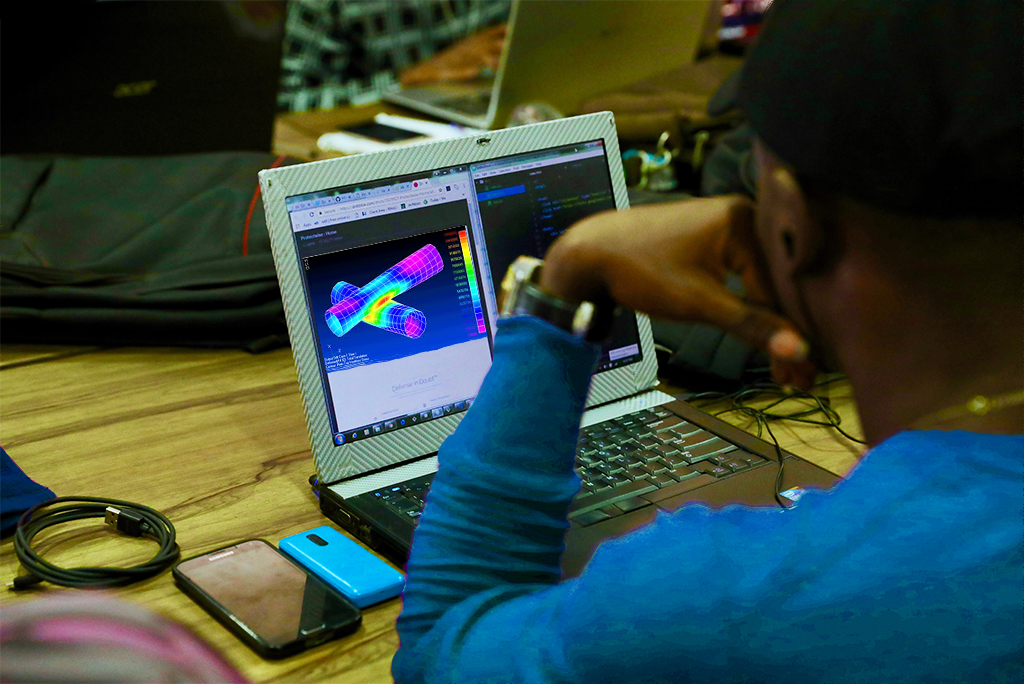
We usually begin with linear analysis to evaluate stress, strain, and deformation under normal loads. This helps us forecast safety factors, potential weak spots, and failure risk.
When a product or structure is slender, tall, or compression-loaded, buckling becomes a silent threat. Through finite element analysis structural checks, we map out when and how a part might collapse.

We use nonlinear material modelling, large deformation analysis, contact simulation, and plasticity prediction to understand how a structure behaves under real-world abuse — impacts, overloads, dents, temperature swings, and assembly forces.
With nonlinear FEA methods, we can capture things linear tools miss.

We identify natural frequencies, mode shapes, and responses to harmonic or random vibration — this is crucial for aerospace parts, vehicles, HVAC units, and rotating machines.
From drop tests, fatigue-inducing shocks, sudden impacts, to structural crash events, finite element analysis simulation lets us replicate events that no one can test physically.
For clients in Dubai, Houston, Aberdeen, and London, blast simulation and fluid-structure interaction (FSI) help us understand structure–fluid coupling under extreme conditions.

We use heat transfer analysis to map temperature flow through materials and systems.
Then pair that with fatigue analysis to estimate life under cyclic loading, which is essential in oil & gas, aerospace, automotive, and industrial equipment.

Sometimes the goal isn’t strength — it’s quietness. We use acoustic finite element analysis to understand sound propagation for quieter systems.
When structures and fluids interact — pipelines, valves, tanks, cooling systems — multi-physics simulation modelling and FSI give insights into performance.

Every project starts with:
We’ve learned that no matter how powerful the finite element analysis software is, good engineering judgment matters more.

If you want proper finite element analysis consulting, not just software outputs, you’re in the right place.
[Contact Fluxiss — Get a Quote]
Finite element analysis (FEA) is a method to test structures digitally before building them. We use it to predict stresses, failures, and performance. It saves cost, improves reliability, and helps clients in the USA, UK, Europe, and UAE avoid redesign and downtime.
We use ANSYS, Abaqus, SolidWorks FEA, COMSOL, NX, Fusion 360, FreeCAD, and Python FEA scripts depending on project complexity. Each tool handles specific tasks — structural, thermal, dynamic, fatigue, or CAE engineering software tools for multiphysics.
Any industry that builds mechanical or structural systems benefits: oil & gas, aerospace, automotive, manufacturing, construction, energy, marine, and consumer products. Computational mechanics analysis, stress simulation, and finite element design help teams reduce failure risks.
If you're designing something exposed to loads, heat, vibration, fluid pressure, or fatigue — you need FEA. We often tell clients: if failure costs money, downtime, or safety risks, finite elemental analysis is the right call.

We’re proudly serving clients across the USA, UK, UAE, and Europe. From corporate giants to research labs and the shipping industry,