
Due to client NDA commitments, the showcased projects represent only a portion of our work and not the full scope of what we’ve delivered.
When you’re moving hundreds of thousands of tons of crude oil through the Arctic, “good enough” engineering doesn’t exist. At Fluxiss, we provide the heavy-duty naval architecture and structural engineering required for the world’s most demanding energy corridors.
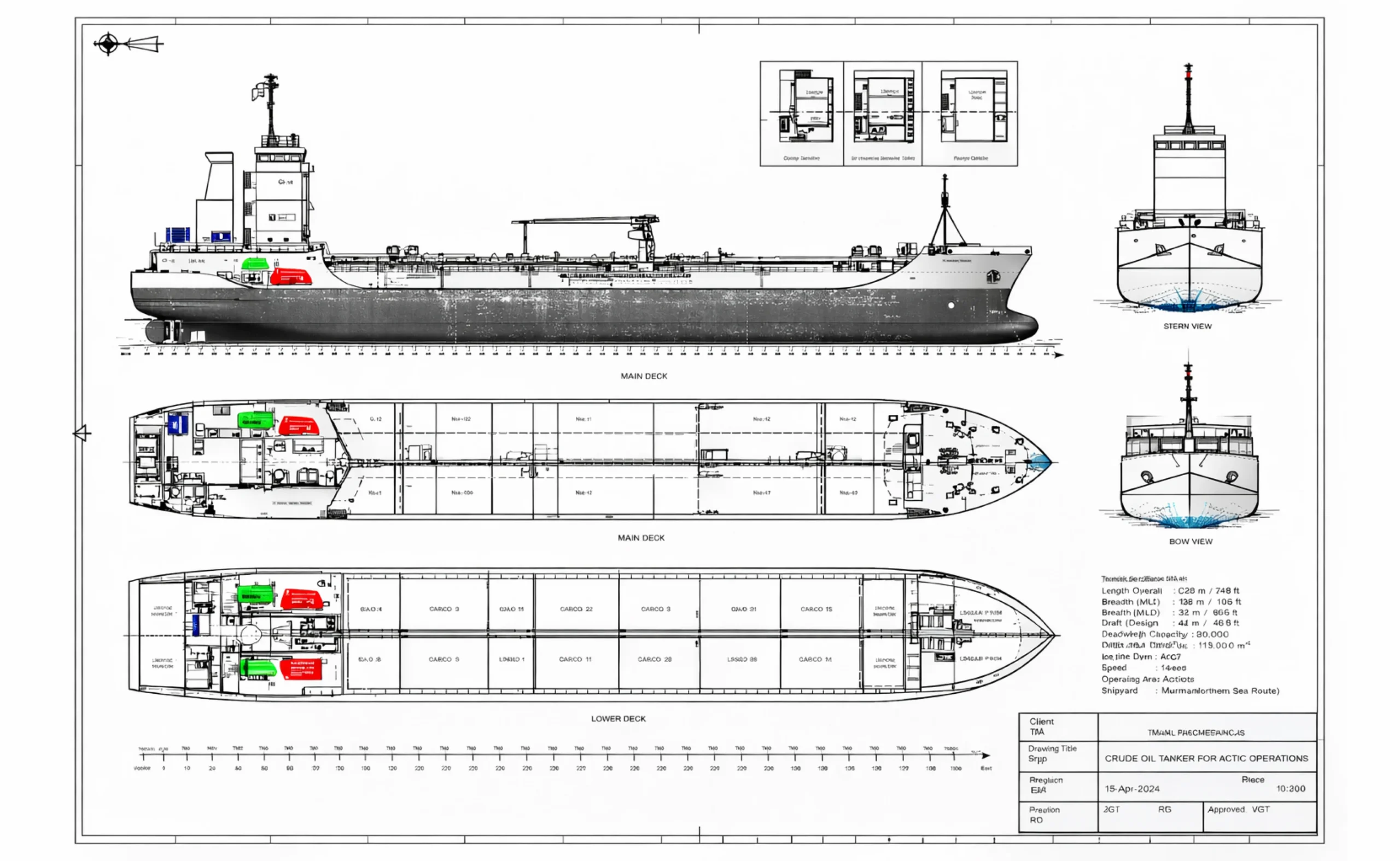
Our team recently completed a comprehensive engineering and certification package for Arctic Sea Lines, operating out of Murmansk. This wasn’t just a standard tanker design; it was an exercise in extreme-environment naval engineering for high-capacity, long-distance transport.
The biggest hurdle in Arctic tanker design is structural fatigue. Most vessels face standard wave loads, but an oil tanker in Murmansk has to contend with a dual-threat environment: massive longitudinal hull stress from heavy cargo and the localized crushing forces of Arctic ice-class requirements.
We had to calculate structural scantlings that could withstand the thermal contraction of sub-zero temperatures without becoming brittle. Furthermore, ensuring damage stability in remote locations is a massive safety concern. If something goes wrong in the Arctic, help isn’t around the corner—the ship’s design must be its own first responder.
Our approach was rooted in rigorous data and compliance. We didn’t just guess at the strength needed; we performed a deep-dive longitudinal strength analysis to ensure the hull wouldn’t buckle under the weight of the crude or the pressure of the sea.
We handled the complex regulatory landscape, ensuring the design met all IMO and SOLAS international standards, alongside specific classification society rules for hazardous cargo. By using specialized naval architecture software, we mapped out the hydrostatic data and created a General Arrangement (GA) that prioritizes both cargo capacity and crew safety in freezing conditions.
Fluxiss delivered a full technical blueprint that allows Arctic Sea Lines to operate with confidence in some of the harshest waters on Earth.
The final package gave the client a vessel that is not only robust enough to survive the Barents Sea but efficient enough to maintain the bottom line for long-distance energy logistics.
Whether you are hauling crude across the poles or containers across the Atlantic, Fluxiss provides the structural engineering and stability analysis you need to stay compliant and profitable.
We’re proudly serving clients across the USA, UK, UAE, and Europe. From corporate giants to research labs and the shipping industry,