




Does Heat Transfer From Hot to Cold?
Does Heat Transfer From Hot to Cold? The Real Science Explained
Have you ever noticed that your morning coffee cools down if you put it on your desk, but your cold soda does not turn hot? Well, it’s kind of a silly question, but in the context of industrial piping in Houston and a high-rise HVAC system in London, physics is what dictates millions of dollars of choices in engineering.
We spent the last few weeks reviewing data from our global thermal simulation projects here at Fluxiss. Clients from New York to Dubai often ask us to optimize their systems, and every single solution comes down to mastering one fundamental question: Does heat transfer from hot to cold, or is there a loophole?
Let’s dive into the absolute reality of how thermal energy behaves, how heat transfer works, and why your engineering systems depend on these rules.
The Cold Hard Truth: Direction of Heat Transfer Explained
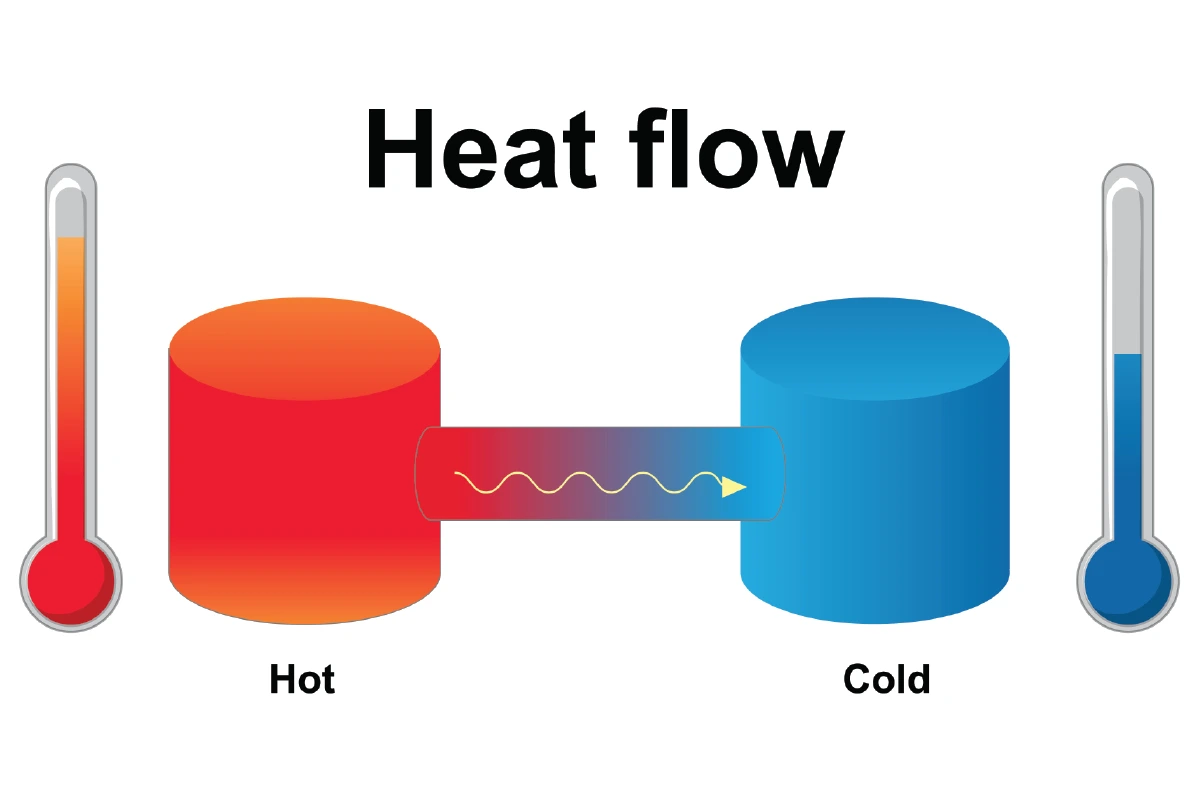
Now, let’s put aside any assumptions immediately. Yes, there is a flow of heat from warm to cold. This street is one-way. We have studied thermal systems and mechanical designs in all these years across the UK and Europe, and never seen energy going backwards from the colder to the warmer side.
Directions of heat transfer are associated with a natural equilibrium. Imagine water that is flowing downhill. The molecules are very active in the high-temperature regions. Molecules move slowly in low temperature areas, and are slow. As the fast molecules collide with the slow ones, the kinetic energy is carried on through the colliding molecules.
Then, why does heat transfer from hot to cold? Nature dislike unbalances. It always attempts to distribute the same energy level throughout until everything reaches the same energy level.
Decoding the System: How Heat Transfer Works on a Molecular Level
The energy transfer process can only be grasped if temperature is perceived.To comprehend the process of energy transfer, it is necessary to view the nature of temperature. Temperature is simply a measure of how the molecules are vibrating.
If a client in Chicago calls us to design a heat exchanger, or a company in Abu Dhabi calls on us for data center cooling, we begin with some basic heat transfer principles and work our way around from there. Energy is never lost and it cannot be created. It must go down the temperature gradient from the region of high thermal intensity to the region of low thermal intensity.
The Three Pillars of Heat Flow Mechanisms
All of the different thermal systems that we optimise at Fluxiss utilizes three of the classic heat flow mechanisms. These, of course, were studied in high school, but their application to actual engineering work is as follows:
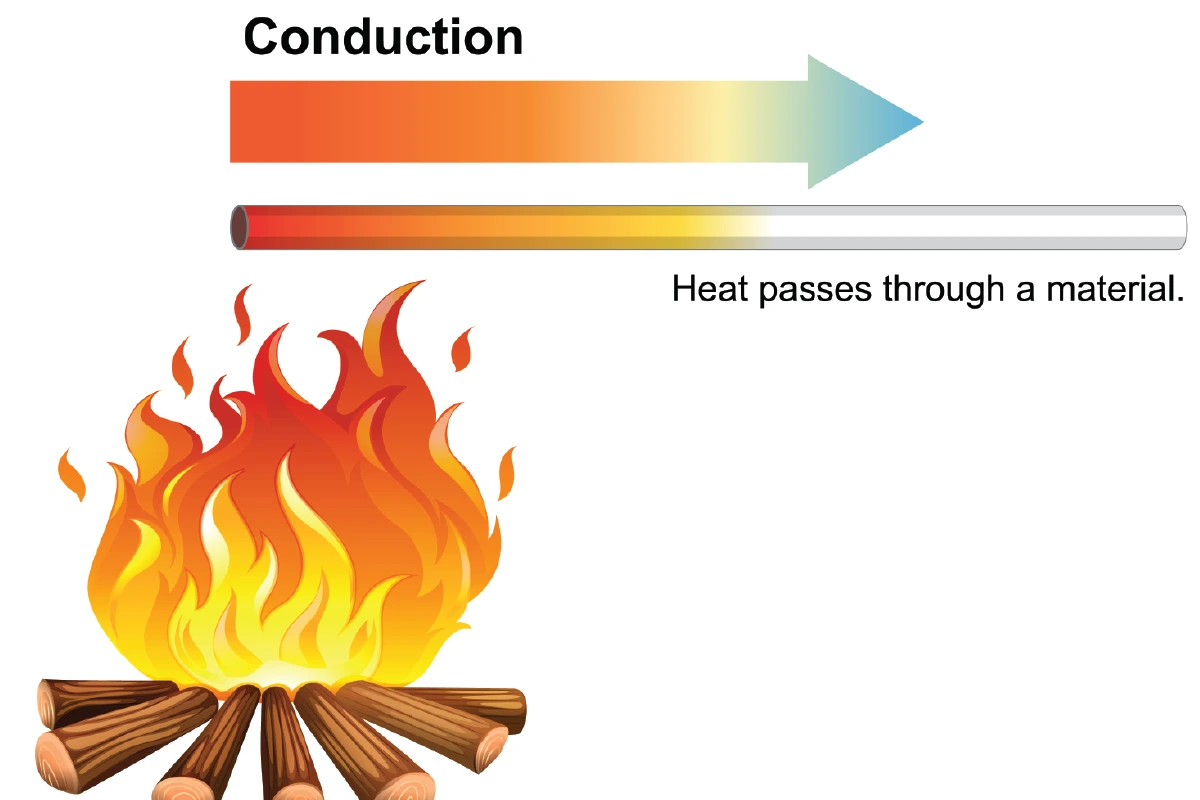
- Conduction: This is through the direct action. When you touch a pipe on a factory which is hot, energy is transferred directly to your hand. Requires a large amount of thermal conductivity of the materials.
- Convection: Refers to the fluid motion. Imagine hot air rising or the flow of liquid through an L.A. commercial building’s chiller facility.
- Radiation: This is energy that flows through electromagnetic waves. Does not require a medium. Radiation is what happens as the sun warms up the earth and also a hot furnace for an industrial facility is warms up the facility in Manchester.
The Science Breakdown: Laws of Heat Transfer and Thermodynamics
Technically, heat flows from hot to cold because of the Second Law of Thermodynamics. This law is new because it contains the concept of entropy, which is nothing more than a measure of disorder.
Nature prefers disorder and dispersion. Concentrated thermal energy (a hot spot) naturally wants to spread out into cooler areas. According to the fundamental laws of heat transfer, net thermal energy will never move from a cooler region to a warmer region without external work being done on the system (like how a refrigerator uses electrical power to force heat out of its interior).
Temperature Difference and Heat Transfer Rates
The speed of this process depends entirely on the temperature difference and heat transfer coefficients of your setup.
Q = hA delta_T
In this basic relation,
- Q represents the rate of heat transfer,
- h is the heat transfer coefficient,
- A is the surface area, and
- delta_T is the temperature difference.
The larger the gap between the hot and cold zones, the faster the energy moves. As that gap closes, the transfer rate slows down to a crawl.
Reaching the End Game: Thermal Equilibrium Explained
What occurs when the warm object cools down and the cold object heats up? They “fall in the middle. The state that this represents is called thermal equilibrium.
Once heats are in balance, the net transfer of heat is completed. The temperatures equalize. You’ll be looking at exchanging energy between your cooling fluid and your machine until the energy levels are equal as you run an industrial process in Frankfurt.
These thermodynamics principles enable our team at Fluxiss to accurately calculate the amount of time a system needs for stabilization, meaning we can safely prevent the components from overheating or being damaged by structural forces.
Real-World Applications: Engineering Across Continents
Controlling the transfer of heat is not only about theory. We use the same thinking to tackle challenging problems for customers across the world at Fluxiss.
- In the US and UK, we build a tighter envelope and MEP systems in the building that make sure that heat doesn’t leak out in winter or in some of the peak heat conditions in summer.
- The UAE-Dubai and Abu Dhabi are involved in large-scale cooling projects where the ambient temperature outside the building is very high, which requires high-performance materials with specific thermal conductivity ratings to maintain the building’s interior temperatures.
- In Europe, we support manufacturing plants in installing heat recovery systems, systems that recover waste energy which is naturally flowing down the gradient and that are reworked to save fuel expenses.
Optimize Your Thermal Systems Today
Whether it’s a tiny electronics system or a huge petrochemical refinery, the laws of heat transfer apply to every mechanical system. Are you experiencing a loss of efficiency, problems with overheating parts or complicated HVAC requirements throughout the USA, UK, Europe, or the UAE? Then you’ve come to the right place, you need a thermodynamics expert!
Let’s make your systems more efficient. Contact the Fluxiss Engineering Team today to consult with our thermal simulation and design specialists.
Frequently Asked Questions (FAQs)
No. Natural thermal energy transfer always goes from high temperature to low temperature. To move heat from a cold area to a hot area, you must introduce external work and mechanical power, which is exactly how air conditioners and heat pumps operate.
The major factor is temperature gradient. The more the temperature varies between two zones or objects that are interacting, more energy will move quickly and intensely from the warmer zone to the cooler zone.
Thermal conductivity is a measure of a material's ability to conduct heat by conduction. Materials are chosen for heat exchangers with high conductivity and insulation with low conductivity to manage heat flow.
It can't be avoided entirely, but it can be slowed significantly, employing vacuum insulation. There are three modes of heat flow: conduction, convection, and radiation, so a perfect vacuum effectively reduces transfer via two modes of heat transfer, convection and conduction.