How Corrosion Reduces the Strength of Offshore Jacket Platforms
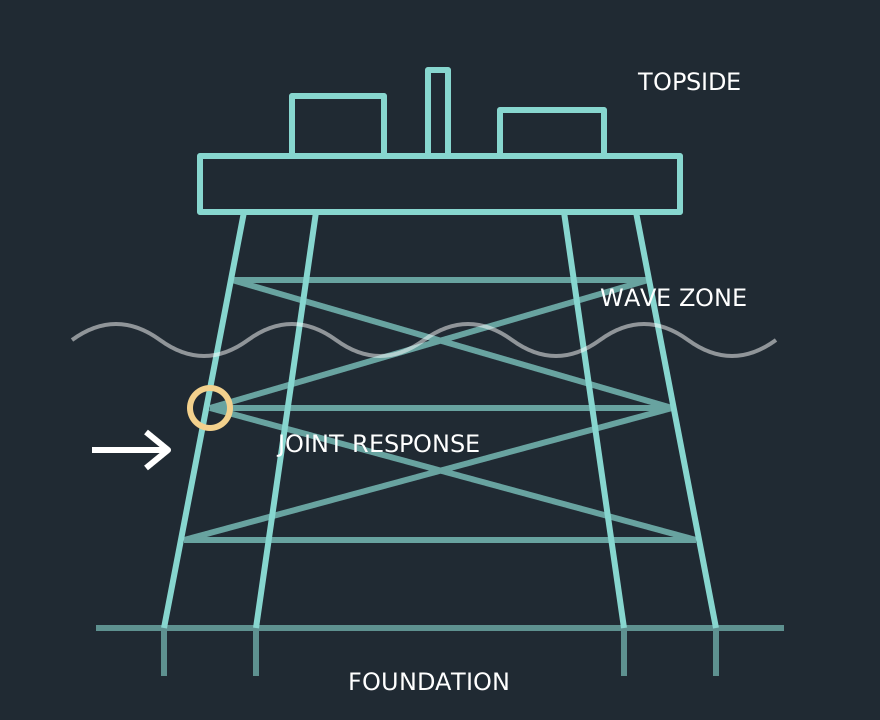
Corrosion changes the structure being analysed. Wall thinning reduces the steel available to carry load, while local pits and damaged regions can alter buckling and fatigue behaviour. A jacket assessment therefore needs a spatial description of deterioration, not merely an age or an assumed annual corrosion rate. The objective is to understand the capacity of the measured condition and the uncertainty over the proposed operating period.
Map the condition before reducing the model thickness
Gather inspection dates, thickness readings, coverage, measurement uncertainty and photographs or scans. Identify splash-zone deterioration, submerged damage, internal flooding, coating breakdown and connection condition. A reading should be traceable to a member, elevation and circumferential position.
Distinguish uniform thinning from pits, grooves and isolated defects. Missing coverage is not evidence of nominal thickness. Where measurements are sparse, define conservative bounds and identify additional inspection that could change the decision. Keep the measured condition separate from any future corrosion allowance.
Understand the effect on section resistance
For a circular tube, area A = π(Dₒ² − Dᵢ²)/4 and second moment of area I = π(Dₒ⁴ − Dᵢ⁴)/64. Changing the wall geometry affects axial stress, bending stiffness and section modulus. These equations describe idealised sections; they do not automatically represent a local defect or a damaged joint.
As an illustrative thin-wall approximation at nearly unchanged diameter, reducing a 20 mm wall to 16 mm removes about 20% of its area. Under the same axial force, average stress rises by roughly 25%, because stress varies inversely with area. That is not a 20% platform-capacity prediction: buckling, bending, joints and load redistribution may govern.
Check local instability and connections
Higher diameter-to-thickness ratios can make tubular walls more sensitive to local instability. A short, severely thinned band may need a different assessment from gradual loss over a long member. Examine brace ends, welded intersections and load introduction regions where wall deformation interacts with member force.
A reduced global beam property may approximate overall stiffness but miss local joint response. Select local shell or other assessment methods when required by defect geometry and the governing failure mode. Check that the local model receives compatible global forces and restraints.
Separate prevention from recovered strength
Coatings and cathodic protection can control future deterioration in their applicable environments. They do not replace steel already lost. DNV-RP-B401 addresses galvanic-anode cathodic protection design; an existing asset also needs an assessment of its current protection condition and project-specific corrosion strategy.
Compare repair options on load transfer, fatigue detail, access, installation state and inspectability. A clamp, sleeve or welded reinforcement introduces its own interfaces and may change stiffness. Assess the repair and its installation sequence instead of assuming that additional metal restores the original behaviour.
Make the operating decision traceable
Report measured thickness, assessment thickness and any future-loss assumptions separately. Show the controlling load cases and the sensitivity to uncertain defect dimensions. Conclusions should identify whether acceptance applies to current operation, a restricted envelope or a defined future period.
HSE treats structural integrity as a continuing lifecycle responsibility. Connect each critical condition to a repair, targeted inspection or reassessment trigger. Fluxiss can scope the structural analysis around inspection data, loading information and proposed modifications so the resulting capacity statement addresses the actual asset.
Frequently Asked Questions
No. Exposure, material, protection system, inspection strategy and intended life determine the basis. Existing metal loss should be measured and assessed separately.
Technical references & further reading
Practical engineering explainers connecting analysis methods, design inputs and project decisions.
Related articles.

Let's Build Something Great Together.
Partner with Fluxiss for engineering that holds up - under pressure, under load, under scrutiny.