
Digital twin life cycle assessment piping is changing how U.S. engineering firms design, maintain, and optimize pipelines. Today, real-time monitoring, simulation, and sustainability analysis across the pipeline lifespan are essential. Digital twins can enable engineers to monitor each asset through installation to decommissioning and forecast failures and effects on the environment. Fluxiss overlays digital twins into their engineering services at the work of enhancing the pipeline performance as a natural process.
Firms are also using services like Fluxiss Services for predictive maintenance and sustainability assessments to optimize pipeline operations efficiently.
Digital twins are virtual models of real-life pipelines, which combine real-time sensor data in order to monitor, simulate, and provide predictive understanding. They can be used with life cycle assessment (LCA) to enable engineers to evaluate the environmental impact in the design to decommissioning process. The monitoring tools employed by the companies allow tracking the emissions and operational performance during the lifecycle much easier.
Digital twins are being pioneered by universities and companies. The UM/ASU NSF Center is devoted to interoperable digital twins that will shorten the design pipeline cycles by 30 percent. Tata Consulting Engineers also deploys offshore wind pipelines virtual asset monitoring to maximize maintenance. The tools provided by Hexagon improve the LCA integration to monitor emissions real time which is commonly used by the U.S. engineering firms in planning the pipelines sustainably.
Anomaly detection, route optimization, and risk assessment are the most common applications of AI in pipeline engineering. The top solutions such as SuperAGI, enable engineers to implement predictive maintenance and LCA efficiently to make pipeline monitoring smarter and lessen downtime.
The combination of predictive maintenance with LCA assists in predicting failures at the cost to the environment. PdM with AI is capable of cutting unplanned downtime by 30 percent in U.S. oilfields, and material reuse through the use of LCA reduces millions of dollars in individual projects.
Machine learning in pipe stress analysis is the prediction of stress points and potential failures based on ILI data. ML enhances safety and efficiency within pipeline systems and is inherent to engineering tools as AutoPIPE, developed by Bentley, popular with engineering companies in the U.S.
Smart infrastructure analysis is an IoT sensor and analytic system that uses real-time measurements of the pipelines to determine their performance. Engineers can use AI and digital tools to automatically minimise leaks and maximize flow to achieve operational efficiency.
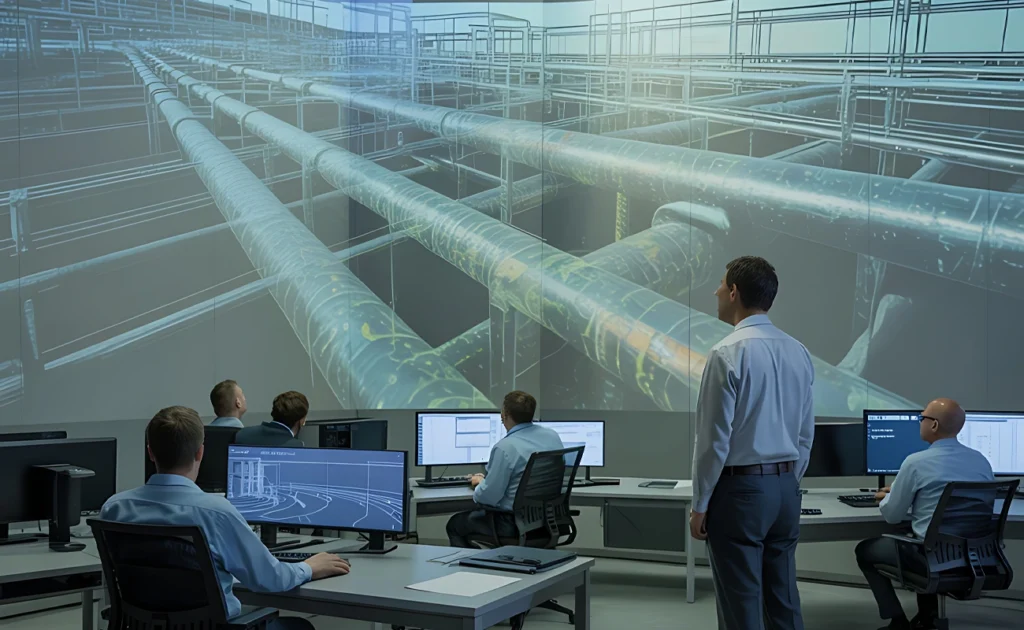
Digital tools for pipeline sustainability automate the LCA and monitor carbon emissions. U.S. companies also use AI-based dashboards, as do international leaders in the energy field, to make pipelines comply with environmental requirements.
Industry 4.0 pipeline systems combine AI, IoT and digital twins to form interconnected and data-driven infrastructure. It improves the data-driven pipeline design, increases the efficiency of operations, and minimizes environmental effects.
IoT-enabled smart piping technologies allow remote monitoring, leak prevention, and automated flow control. U.S. energy firms are increasingly adopting these technologies for operational reliability and sustainability
AI-driven LCA benefits are filling gaps in data, speeding up the assessment, and decreasing the costs. Most engineers incorporate AI-assisted LCAs to real-time monitoring, which has guaranteed compliance and sustainable pipeline operations.
Multi-layered IoT and AI integration is what will be focused on in the future of pipeline monitoring. Digital twins and predictive analytics minimize maintenance requirements, enhance performance, and enhance sustainability to make pipelines efficient and safe up to 2033.
Digital twin life cycle assessment piping, AI in pipeline engineering, and predictive maintenance with LCA are practical tools transforming U.S. pipeline systems. Combining smart infrastructure analysis, digital tools for pipeline sustainability, and machine learning in pipe stress analysis is now essential for operational success. Explore Fluxiss for services that integrate these solutions, and take the first step toward modernizing your pipelines by contacting Fluxiss Contact.
Digital twin pipeline life cycle assessment piping is the combination of virtual pipeline models and LCA to track the performance, predict failure, and the environmental impact throughout the life of the asset.
AI in pipeline engineering is utilized to analyze both real-time and historical data to identify anomalies, optimize routes, and enhance the performance and safety of the pipeline.
Predictive maintenance with LCA is a method that reduces unexpected downtime, minimizes costs, and incorporates sustainability assessments into the maintenance scheduling.
Digital tools for pipeline sustainability automate data collection, track emissions, and provide actionable insights for greener pipeline operations.
Yes, machine learning in pipe stress analysis predicts stress points and potential failures, helping engineers maintain pipeline integrity.
Industry 4.0 in pipeline systems integrates AI, IoT, and digital twins to create connected, efficient, and sustainable pipelines.
The future of pipeline monitoring will rely on AI, IoT, and digital twins for predictive maintenance, performance optimization, and sustainability compliance.
We’re proudly serving clients across the USA, UK, UAE, and Europe. From corporate giants to research labs and the shipping industry,