Refining Reliability: Piping Stress Analysis for High-Pressure Systems

Due to client NDA commitments, the showcased projects represent only a portion of our work and not the full scope of what we’ve delivered.

Engineering isn’t just about making things fit; it’s about making sure they don’t break under pressure. At Fluxiss, we specialize in the mechanical integrity of complex industrial systems. Whether you are operating a refinery in Texas or a processing plant abroad, our team ensures your infrastructure meets rigorous global standards like API and ASME.

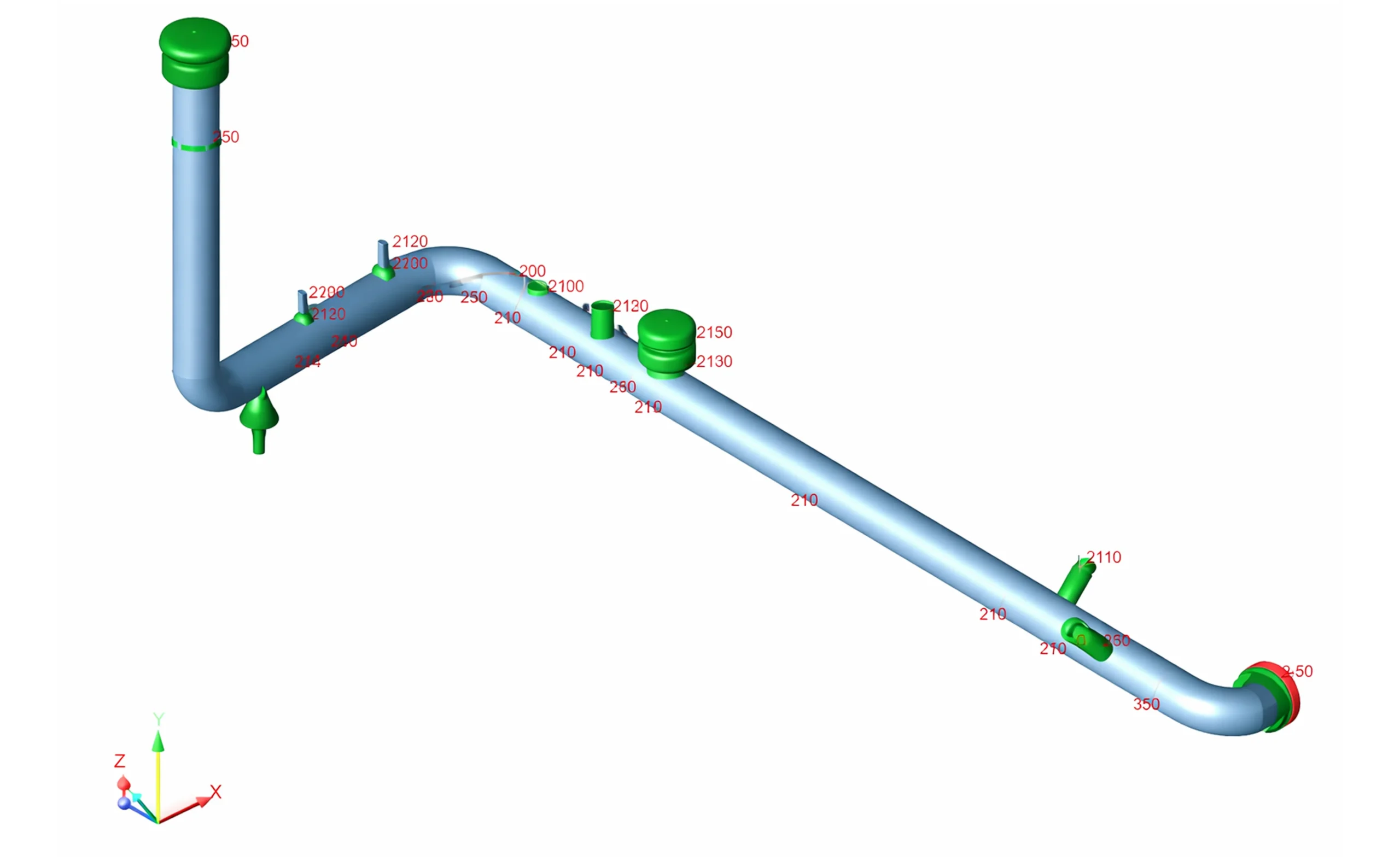
Recently, we tackled a critical piping stress challenge for a Refinery Upgrading Project (Line HPS-741-149-A6S1-6”-ET). Here is how we turned a failing system into a compliant, safe, and efficient operation.

The Nozzle Failure: Why “Good Enough” Design Isn’t Safe

The Challenge: High Stress and Equipment Overload

In the initial design phase, the piping connected to the compressor (Node 350) was a major liability. Without proper support, the system was pushing its limits.

  • Sustained Stress Crisis: The maximum sustained stress at the elbow (Node 310) reached 96.4% of its allowable limit. While technically “passing,” it left zero margin for real-world fluctuations.
  • API-617 Non-Compliance: The most critical issue was the force exerted on the compressor nozzle. Under hydrostatic testing and operational loads, the forces and moments failed API-617 standards across all five primary load cases.
  • Uncontrolled Displacement: The free end of the line (pipe cap) exhibited excessive movement in the Y and Z directions during operation, threatening the long-term health of the connected machinery.

The Result: A 75% Reduction in Stress and Full API Compliance

Our engineers didn’t just add hardware; we strategically introduced a Simple Support at Node 80, located exactly 315mm from the vertical pipe run. The impact was immediate and measurable:

  • Stress Drop: Sustained stress plummeted from 96.4% down to a safe 22.2% of the allowable limit.
  • Nozzle Protection: By redistributing the load to the new support, we brought the forces on the compressor nozzle within API-617 limits. The nozzle now passes all load cases, ensuring the compressor’s internal seals and bearings are protected.
  • Controlled Movement: We stabilized the system, reducing expansion stresses to a negligible 1.9% of the limit.

Seismic Analysis for Commercial Buildings: Defeating the Ground Shake

The Challenge: High-Occupancy Safety in Seismic Zones

Commercial structures in high-risk zones face a dual threat: the need for aesthetic flexibility and the absolute requirement for lateral stability. Traditional designs often fail to account for the specific resonance of a building’s unique “footprint” during a seismic event.

  • Torsional Irregularity: Many modern buildings feature asymmetrical designs that twist during earthquakes, leading to localized structural failure.
  • Dynamic Load Distribution: Standard static calculations often miss how a building’s mass shifts during peak ground acceleration.

The Result: Resilient Structures That Stay Standing

Using advanced finite element modeling, Fluxiss provides comprehensive seismic audits. We don’t just tell you if it fails; we tell you how to fix it.

  • Optimized Damping: We identify the exact placement for shear walls or braced frames to neutralize torsional forces.
  • Code Compliance: Every report we generate ensures the building meets or exceeds local building codes and ASCE 7 standards.
  • Cost Efficiency: By identifying high-stress points early, we prevent the over-engineering of safe zones, saving developers significant material costs on steel and concrete.

Ready to secure your infrastructure? Don’t wait for a failure to find the weak points in your system. Whether it’s API compliance for refineries or seismic safety for your next high-rise, Fluxiss delivers the data you need to build with confidence.
Get a Technical Consultation Today