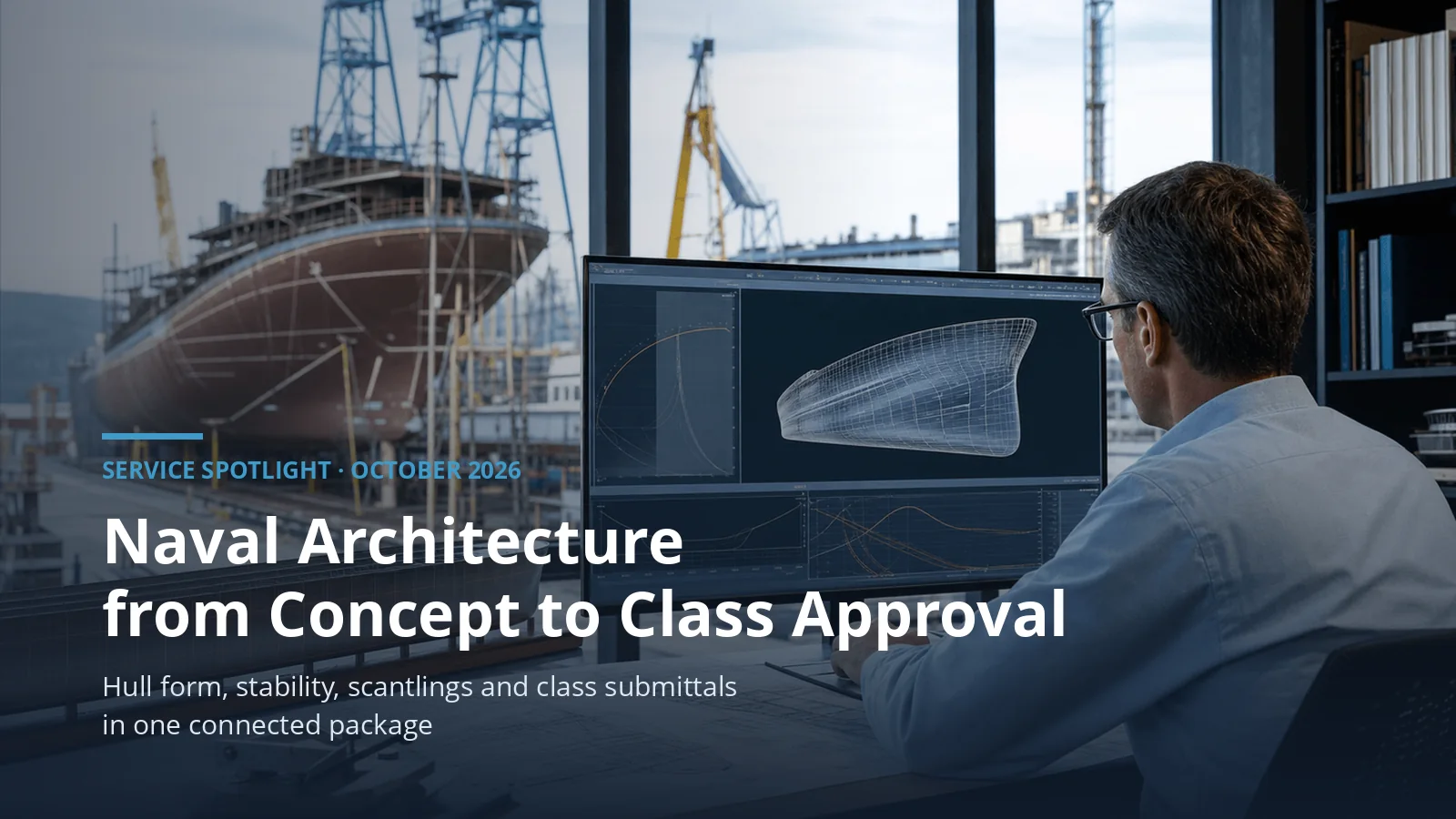
This service spotlight follows the Fluxiss Naval Architecture service from the first concept study to a package that a classification society can review. The published scope covers hull design and hydrodynamics, barge and vessel conversion, intact and damage stability, and structural design for class, with Lloyd's Register, ABS and DNV rules as the reference framework and Maxsurf and ANSYS AQWA among the listed tools. Treating these as one connected workflow matters because a change in hull form, weight distribution or structural arrangement affects stability, powering and class compliance at the same time.
Conceptual and Preliminary Design sets the basis. A feasibility and mission study records the operating profile, route, payload, speed and regulatory regime, and concept development turns those requirements into principal dimensions, a general arrangement and a first lines plan. Hydrostatics and stability work then checks buoyancy, displacement, trim and heel against the intended loading conditions, while hull form optimisation addresses resistance and powering, with Computational Fluid Dynamics available to verify the estimates. A weights and centres of gravity analysis at this stage keeps later decisions anchored to a realistic lightship estimate rather than an optimistic one.
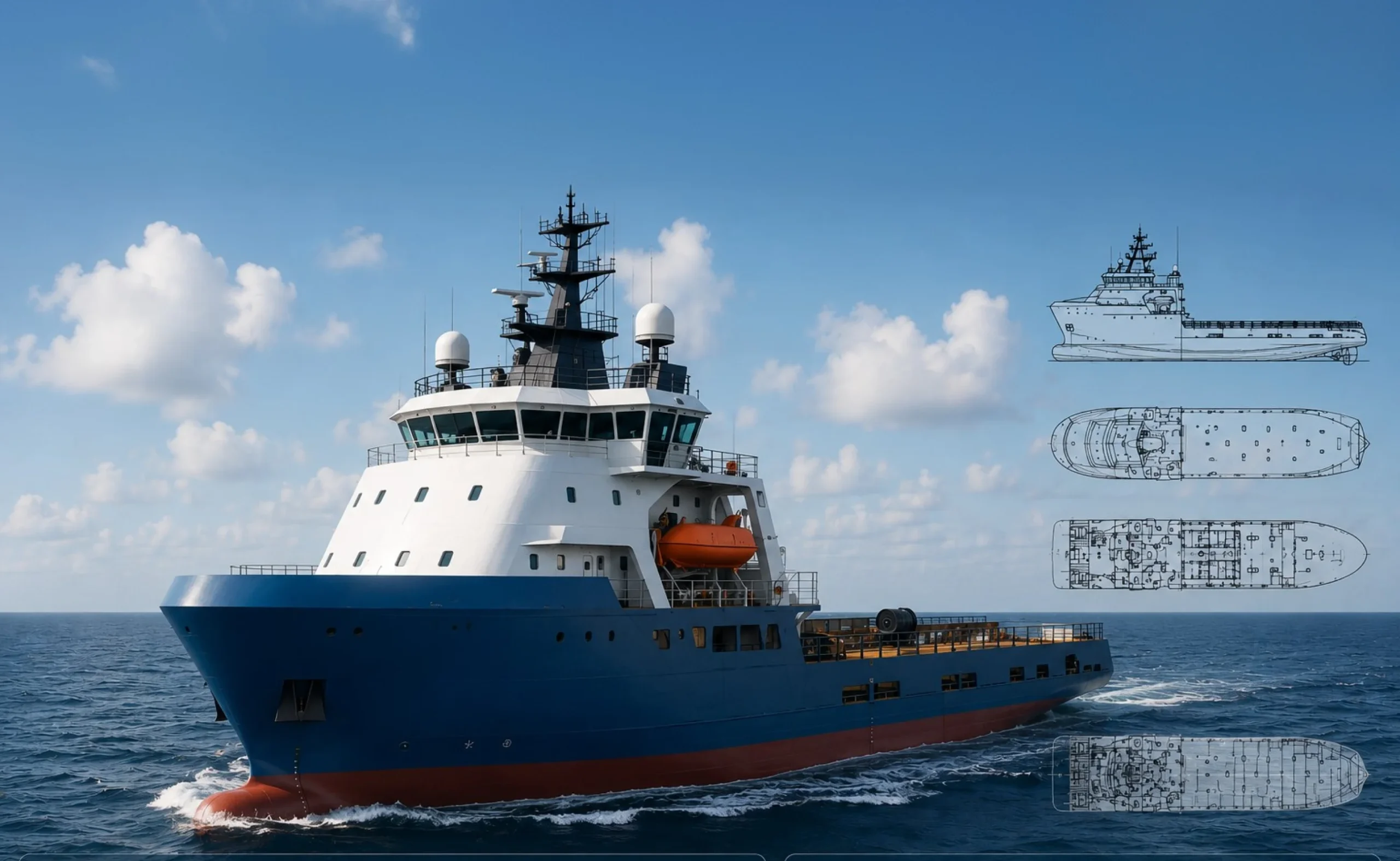
“See how Fluxiss links hull form, hydrostatics and stability, structural scantlings, detailed systems engineering and production drawings into one class-ready naval architecture package.”
Detailed Engineering develops the approved concept into a buildable vessel. Structural design and scantling define plating, stiffeners, frames and bulkheads against the governing rule set, with Finite Element Analysis applied where local loads, openings or conversions fall outside prescriptive checks. Propulsion system integration aligns engine, shafting and propeller selection with the hull, and piping and electrical layouts cover fuel, ballast, cooling and freshwater systems alongside power distribution and cable routing. Conversion projects add a survey stage, because the existing structure, tank arrangement and stability documentation must be verified before modifications are designed.
Production and Support carries the design into the shipyard. The drawing package for construction brings together fabrication drawings, assembly layouts and piping details, and classification society submissions are prepared and coordinated through approval with ABS, DNV or Lloyd's Register. The stability booklet and inclining test support listed in the service scope belong to this stage as well, since the as-built lightship and centre of gravity confirm or correct the design assumptions. Where a project involves fixed or floating offshore units rather than a trading vessel, the Offshore Structural Engineering service covers the structural side of that work.
For readers new to the subject, our guide to what naval architecture is and how it works explains the building blocks of the discipline, the article on how ships are designed walks through the design spiral, and the comparison of naval architecture and marine engineering clarifies where the two roles meet. The Naval Architecture Master Workbook on the products store supports hydrostatic and load-case checks for teams that run their own preliminary calculations. These resources use the same vocabulary as the project deliverables, which makes review discussions quicker.
Fluxiss lists a naval architecture report, stability booklet, lines plan and hull model, structural drawings, class submittal package and compliance summary among the available deliverables, with an indicative programme of 15 to 30 business days depending on scope. To discuss a vessel, barge or conversion project, contact Fluxiss with the vessel type and dimensions, operating profile, flag and class requirements, available drawings or models, and the approval stage you need to reach. Clients can also schedule a technical meeting with the naval architecture team to review the inputs before a proposal is prepared. Rule sets, software, analysis methods and deliverables are confirmed through the agreed scope rather than assumed from a general service description.
Fluxiss Team contributes services insights to the Fluxiss content library.
Related articles.

Let's Build Something Great Together.
Partner with Fluxiss for engineering that holds up - under pressure, under load, under scrutiny.