
EPC Management for Renewable Energy Projects
EPC procurement, engineering and construction management, commissioning, FIDIC/NEC contract administration and handover for renewable projects.
Between financial close and commercial operation, renewable projects are won or lost in execution. Fluxiss acts as the Owner's Engineer and EPC manager, protecting technical scope, schedule, quality, safety, commercial position, and operational readiness from tender strategy through the defects liability period.
Our management approach connects engineering, procurement, construction, project controls, contract administration, and commissioning. Decisions are recorded against the approved basis of design and programme, giving the owner one current view of progress, interfaces, risks, changes, and actions.
From Tender to Construction

EPC Procurement & Contractor Selection
Fluxiss develops the scope of work, employer's requirements, technical schedules, deliverable register, battery limits, responsibility matrix, programme requirements, testing criteria, and tender return structure. A consistent package makes bids easier to compare and reduces qualifications that later become variation claims.
Technical bids are normalized against the same design basis. We evaluate compliance, exclusions, deviations, proposed equipment, key personnel, delivery plan, subcontracting strategy, quality systems, safety performance, and evidence from comparable projects. Clarification questions and negotiation points are tracked through to an auditable recommendation.
- Contractor and supplier pre-qualification with capability and capacity checks.
- Technical and programme bid evaluation with risk-adjusted comparison.
- Scope alignment, value engineering, and negotiation support before award.
Engineering Management
Design submissions are controlled through a document register with planned and actual dates, reviewer responsibility, comment status, and revision history. Reviews cover compliance with the employer's requirements, codes, permits, grid obligations, equipment interfaces, constructability, maintainability, and operational access.
Interdisciplinary reviews close gaps among civil, structural, electrical, mechanical, controls, communications, fire protection, and OEM packages before they reach site. Critical changes are tested for cost, programme, performance, permitting, warranty, and contract consequences.
Procurement Management
The procurement plan identifies long-lead equipment, required-on-site dates, manufacturing hold points, documentation prerequisites, inspection levels, logistics constraints, import requirements, storage conditions, and replacement options. Schedule risk is monitored from purchase order through manufacture, shipment, delivery, preservation, and installation.
For factory acceptance testing, Fluxiss reviews the procedure in advance, confirms the test equipment and acceptance criteria, witnesses critical tests, records punch items, and verifies that release for shipment is supported by complete evidence. Supplier concessions or deviations remain visible through site acceptance and warranty handover.
- WTG, module, inverter, transformer, switchgear, SCADA, and BESS expediting.
- Inspection and test plans, FAT witnessing, release notes, and quality dossiers.
- Logistics, heavy-lift, preservation, storage, and site-delivery coordination.

Construction Management & Site Supervision
Site supervision converts approved design into verified work. The Owner's Engineer monitors mobilization, method statements, inspection requests, material traceability, civil works, equipment installation, cable and earthing works, quality records, safety observations, daily constraints, and physical progress against the approved programme.
Nonconformances are logged with technical disposition, responsible party, target closure, and verification evidence. Fluxiss also monitors RFIs, design changes, site instructions, quantities, milestone evidence, and interfaces with utilities and authorities so unresolved work does not disappear behind reported progress.
- Quality surveillance, witness and hold points, testing records, and as-built capture.
- HSE observations, permit-to-work interfaces, and corrective-action follow-up.
- Progress measurement, look-ahead planning, constraint removal, and recovery actions.

Commissioning, Contracts & Handover
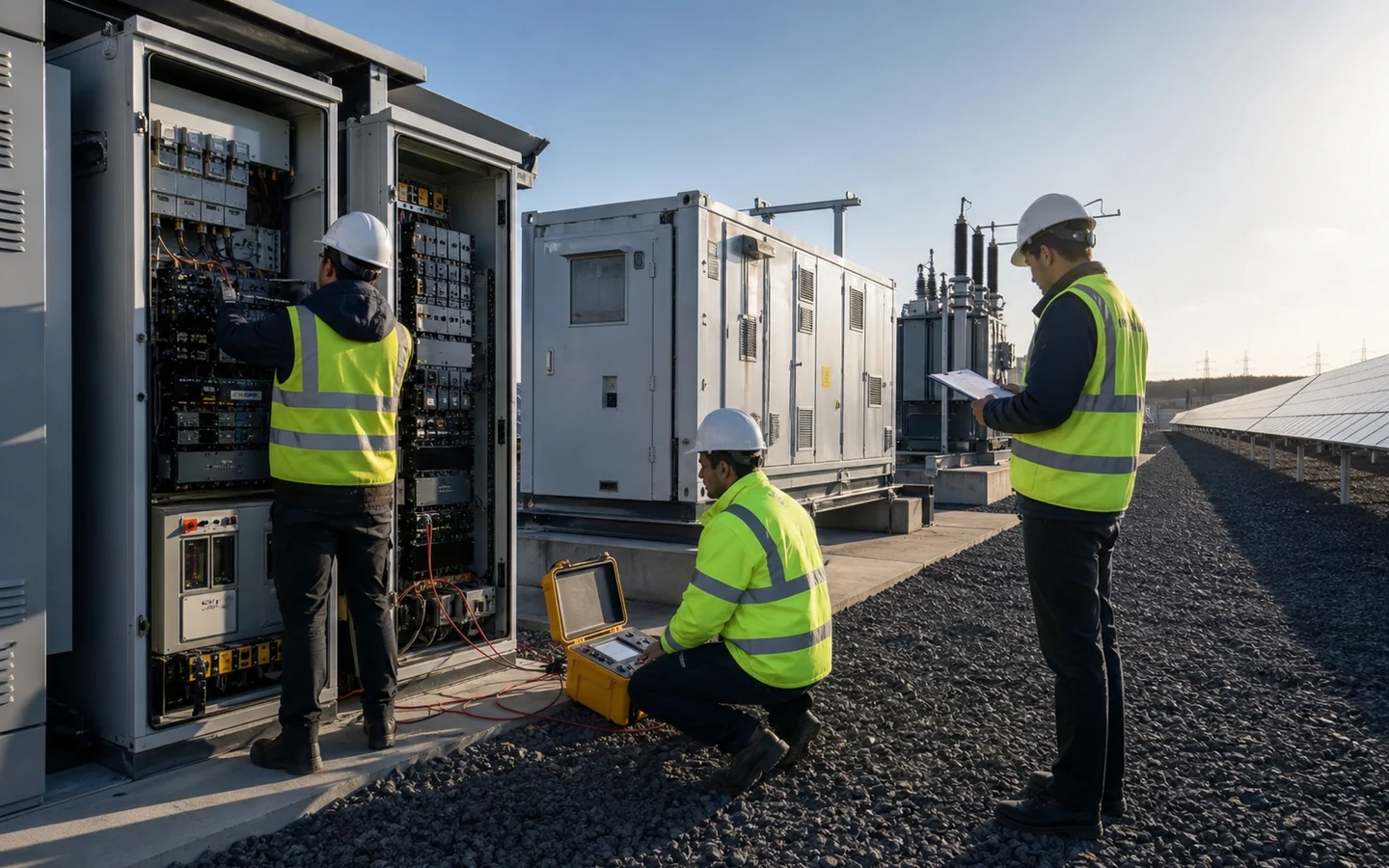
Commissioning & Performance Testing
Commissioning begins during design, not after construction. We develop the system breakdown, turnover sequence, prerequisites, energisation plan, test packs, responsibilities, temporary power needs, utility coordination, and acceptance records early enough to influence the programme.
Fluxiss witnesses pre-commissioning, protection and control tests, communications checks, functional sequences, energisation, reliability runs, and contractual performance tests. Metering accuracy, reference-condition corrections, data exclusions, and acceptance calculations are agreed before the test window so results can be certified without avoidable dispute.
- Solar performance ratio, wind power-curve, availability, and BESS capacity testing.
- SCADA, PPC, protection, revenue metering, and grid-compliance verification.
- Punch-list prioritization, defect closeout, retesting, and acceptance certification.

EPC Contract Administration
Notices, instructions, variations, extension-of-time submissions, claims, milestone evidence, and payment applications are reviewed against the contract and contemporaneous project records. Technical entitlement, cause, effect, mitigation, quantity, and programme impact are separated so the owner can make timely, defensible decisions.
EPC Risk Management
The live risk register links each risk to an owner, trigger, mitigation, due date, residual exposure, cost or schedule allowance, and supporting action. Interface, design, supply-chain, weather, permitting, grid, safety, quality, and commissioning risks are reviewed at a frequency appropriate to the project phase.
Handover & Operational Readiness
Before takeover, Fluxiss checks as-built drawings, redlines, test certificates, settings files, asset registers, warranties, spares, special tools, O&M manuals, training, permits, software backups, cyber-access arrangements, and unresolved punch items. The handover matrix shows what is complete, conditionally accepted, or still outstanding.
During the defects liability period, recurring alarms, performance shortfalls, warranty claims, incomplete documentation, and latent defects are tracked to verified closure. This protects the owner's rights while the operating team gains confidence in the new asset.
One accountable team can support the project from notice to proceed to reliable operation and final defect closeout. Bring in an Owner's Engineer
Related scopes.
Let's Build Something Great Together.
Partner with Fluxiss for engineering that holds up - under pressure, under load, under scrutiny.