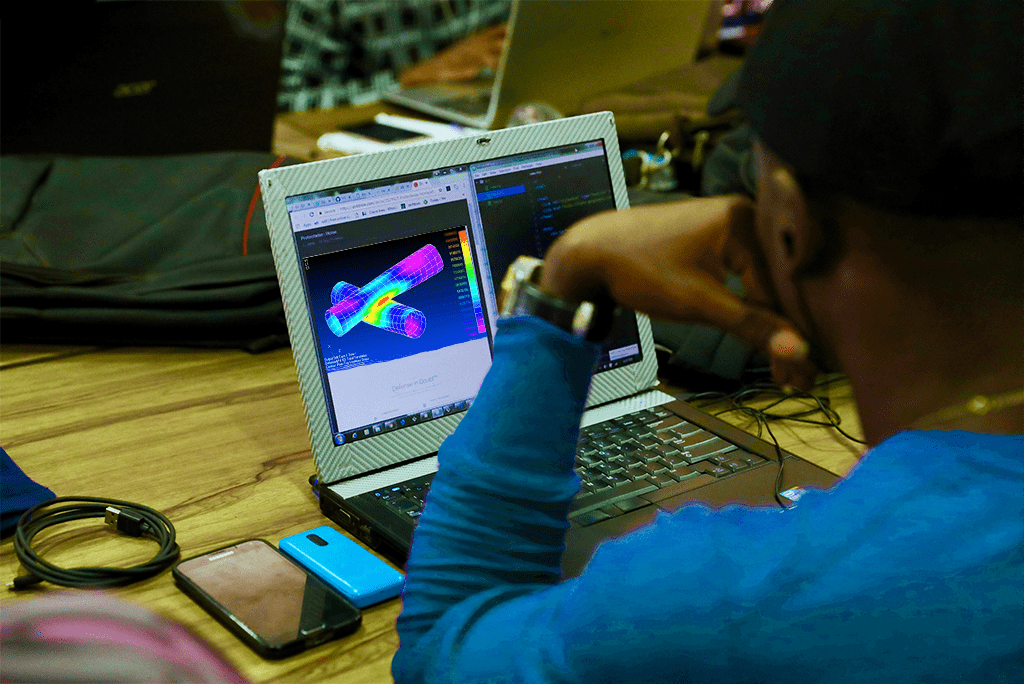
Mesh convergence asks whether further discretisation refinement materially changes a specified result. It is more precise than asking whether a model has enough elements. A study should name the quantity that controls the decision: displacement, reaction, structural stress, contact pressure or another defined output. Different quantities in the same model may converge at different rates.
Choose the output before choosing a mesh size
Identify the location, averaging convention and extraction method. For a deflection limit, use the relevant displacement component at a reproducible point. For a fatigue detail, use the stress definition required by the selected assessment method. Comparing the largest stress anywhere in each mesh may compare different physical locations.
Set a project-specific convergence tolerance that reflects available margin and consequence. A universal percentage can be misleading: a small numerical change may matter when the result lies near a limit, while uncertainty in the applied load may outweigh another case's discretisation error.
Refine systematically
Create a sequence with consistent element family, geometry and boundary conditions. Refine high-gradient regions and confirm that transitions remain adequate. For solid bending models, check through-thickness resolution; for shells, document thickness and offsets as well as in-plane refinement.
Record element size, degrees of freedom, solver settings and the selected output for each run. If you also change contact, material data or fillet geometry, treat that as a separate sensitivity study. Otherwise you cannot attribute the result difference to the mesh.
Read a simple convergence table
Suppose a displacement is 2.40 mm, 2.52 mm and 2.55 mm on successive refinements. Relative to the finer value, changes are approximately 4.76% and 1.18%. This sequence suggests stabilisation of that displacement, subject to further evidence and the project's acceptance tolerance.
It does not prove that stress is converged, quantify all numerical error or validate the applied load. Where appropriate, additional meshes and an asymptotic error-estimation method provide stronger evidence. Avoid reporting an exact continuum solution merely because two mesh results are close.
Distinguish unresolved stress from a singularity
If a peak continually rises near an ideal sharp corner while deformation and nearby stresses stabilise, investigate a possible singularity. Check whether the real detail has a radius, a weld profile or a finite contact area that the idealisation omits. Preserve the physical load path when improving that representation.
Some code assessment methods intentionally use structural stresses away from a local notch. Apply those extraction rules consistently rather than selecting a convenient low value. Document why the chosen quantity answers the failure question.
Separate mesh checks from model validation
A finely discretised model can still have the wrong restraint or load. Pair the convergence study with equilibrium checks, a benchmark and sensitivity to uncertain interfaces. ASME's V&V framework provides a useful distinction between numerical verification and validation against relevant physical evidence.
The final report should show the refinement sequence, selected result, acceptance tolerance and remaining limitations. Supply enough information to reproduce the extraction. Fluxiss can include this verification record within a broader FEA review or design assessment.
Frequently Asked Questions
No. Size depends on geometry, element formulation, stress gradients and the output being assessed.
Technical references & further reading
Practical engineering explainers connecting analysis methods, design inputs and project decisions.
Related articles.
Let's Build Something Great Together.
Partner with Fluxiss for engineering that holds up - under pressure, under load, under scrutiny.