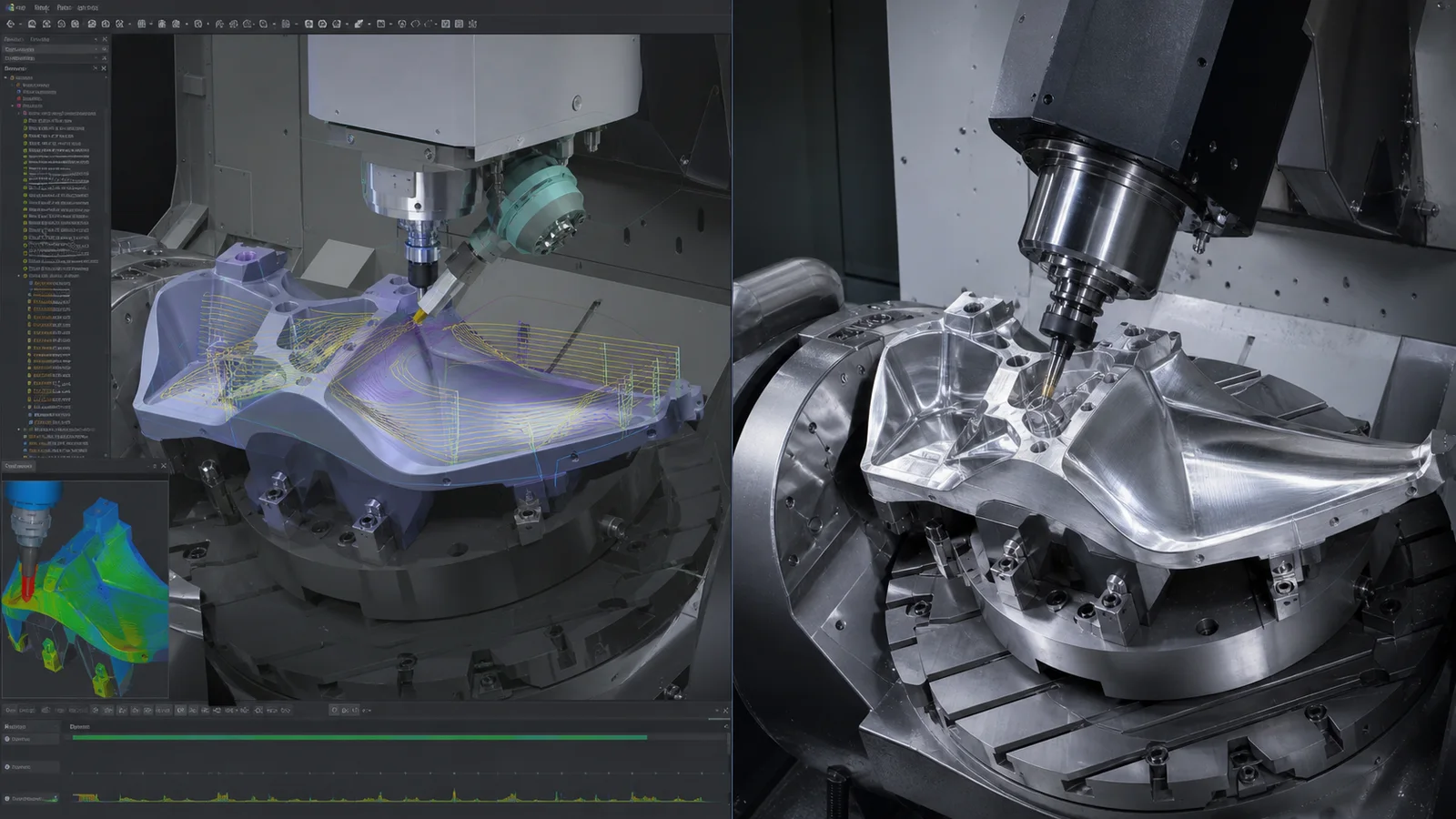
This service spotlight explains how the Fluxiss Computer Aided Manufacturing service turns an approved design into information a workshop can run without guesswork. CAM sits between the model and the machine: it converts geometry into toolpaths, checks them before any metal is cut and prepares the fixtures, programs and prototypes that let production start cleanly. Fluxiss supports machine shops, product teams and engineering departments across the USA, UK, Europe and the UAE, and the work follows the same three threads on every job: CNC programming, rapid prototyping and tooling.
CNC Programming is the first thread. Fluxiss prepares 2-axis and 3-axis milling and turning programs and multi-axis toolpaths for 4-axis and 5-axis machines, with roughing and finishing strategies chosen to keep tool load constant rather than swinging between idle passes and overload. Canned cycles are used for drilling so programs stay compact, pocket and contour routines are tuned for cycle time, and every toolpath is simulated and verified in CNC machining software before it is posted. Outputs are post-processor ready for the client's machine controls, so operators receive production-ready files rather than code that needs editing at the control.
“How the Fluxiss Computer Aided Manufacturing service carries an approved CAD model onto the shop floor: verified 2-axis to 5-axis toolpaths, DfAM-ready prototypes for SLA, FDM and SLS, and fixtures, jigs and molds that hold accuracy in production.”
Rapid Prototyping and Additive Manufacturing is the second thread. Before a part is printed, Fluxiss reviews it for design for additive manufacturing: wall thicknesses, overhangs, layer orientation, support strategy and, where weight matters, topology optimisation that removes material only where the load path allows. Models are prepared specifically for the process in hand, whether that is SLA for fine detail and smooth surfaces, FDM for functional checks or SLS for support-free nylon parts, with drainage holes, orientation and support placement decided in the file rather than discovered at the printer. The aim is a print that works the first time and a prototype that can be validated against the design intent.
Tooling and Fixture Design is the third thread and the one most often underestimated. Fluxiss designs CNC workholding, welding and assembly fixtures, jigs and molds that locate the part repeatably from shift to shift, with manufacturability checks and cycle-time review built into the design. Mold work covers draft, thermal management and wear so that tooling for volume production does not fail early, and fixture designs are validated against the toolpath so clamps, studs and tool access never collide. The result is a setup that any operator can repeat and a scrap rate that stops depending on who is on the machine.
All three threads start from controlled design data. Computer Aided Design and 3D Parametric Modeling deliver editable geometry, 2D Technical Drafting fixes the dimensions, datums and tolerances the machinist will inspect against, and Reverse Engineering provides that data when only a worn part or an old drawing exists. Where a tooling or fixture design carries significant load, Finite Element Analysis is scoped to confirm stiffness and deflection before steel is ordered. Our guides to what CNC programming is, how a CNC machine is programmed and the advantages of computer aided manufacturing, together with the CAE spotlight and the reverse-engineering spotlight, show how these services connect.
A useful CAM enquiry includes the CAD model or drawings, material and stock condition, batch size, the machine make, control and axis configuration, available tooling and workholding, the surface finish and tolerance requirements, and whether prototypes, fixtures or molds are needed alongside the programs. State the delivery format the shop expects, such as native CAM files, posted NC code or setup sheets. Teams can contact Fluxiss with that information or schedule a technical meeting to agree the scope, verification method and deliverables before programming begins.
Fluxiss Team contributes services insights to the Fluxiss content library.

Let's Build Something Great Together.
Partner with Fluxiss for engineering that holds up - under pressure, under load, under scrutiny.