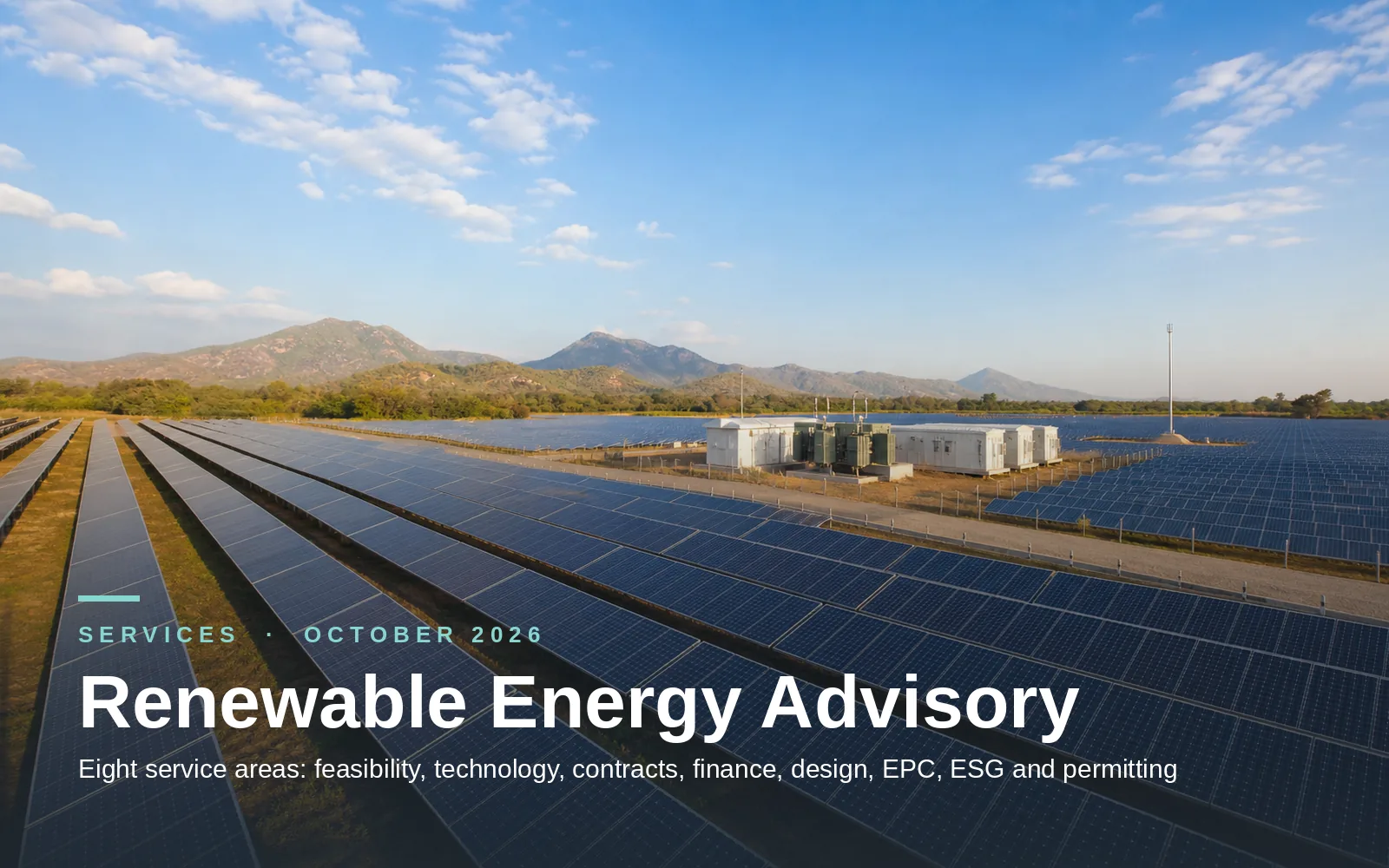
Fluxiss has organised its renewable energy advisory into eight service areas on fluxiss.com, each with its own page and scope list, so developers, lenders, EPC contractors and asset owners can match a question to the right piece of work before a proposal is written. The practice covers utility-scale and commercial and industrial solar PV, onshore wind, battery energy storage, hybrid systems and Power-to-X, and is built around bankable deliverables: reports and models structured so that lenders, utilities and permitting authorities can accept them.
The first four areas support the decision to invest. Feasibility and technical due diligence includes solar PV feasibility studies in NREL SAM, independent wind resource and energy yield assessments at P50, P90 and P99, BESS feasibility and sizing, hybrid solar, wind and storage design and Power-to-X studies. Technology and equipment assessment reviews wind turbine generators, solar PV components and systems, BESS degradation and augmentation strategy, and the track record, certification and bankability of suppliers. Contract and technical risk review covers PPAs, turbine supply agreements, EPC and balance-of-plant contracts, BESS long-term service agreements and interconnection and grid-compliance obligations. Financial modelling and techno-economics turns those inputs into CapEx and OpEx assessments, NPV, IRR and LCOE models, sensitivity and scenario analysis and a technical inputs package for the client's own financial model.
“Solar, wind, BESS and hybrid projects can now be scoped against eight defined advisory areas on fluxiss.com - feasibility and due diligence, technology assessment, contract risk review, financial modelling, engineering design, EPC management, ESG strategy and project controls - each with its own page, scope list and deliverables.”
The remaining four carry a project through delivery and reporting. Engineering design of renewable systems spans hydropower, solar PV, wind, biomass and bioenergy, small hydro and run-of-river schemes, geothermal, hybrid and integrated systems and grid and substation design. EPC management covers contractor selection and procurement, engineering and construction management, site supervision, commissioning and performance testing, contract administration, risk management and handover to operations. ESG strategy and sustainability reporting provides Net Zero and SBTi roadmaps, TCFD climate risk assessments and ESG KPI frameworks with impact reporting. Project controls, permitting and compliance brings Primavera P6 scheduling and S-curve monitoring, permitting and regulatory compliance for solar and wind projects, and KPI dashboards for progress tracking.
Standard deliverables across the eight areas are a feasibility or due-diligence report, an energy yield assessment at P50, P90 and P99, a technology and bankability review, a financial model inputs package, contract risk review memos and an ESG and Net Zero roadmap. The work is referenced to IEC 61400 for wind turbines and IEC 61215 for PV modules, modelled in NREL SAM and RatedPower and scheduled in Primavera P6, with a typical turnaround of 10 to 20 business days depending on scope.
The advisory areas sit on top of the solar engineering and design work Fluxiss already delivers for projects in the USA, UK, UAE and Europe: PV array layout and string sizing, mounting structure and foundation design against wind, snow and seismic loads, stamped permitting packages and grid-connection electrical design. One example from our portfolio is the structural vetting of a commercial PV field in California, where racking reactions were checked against ASCE 7 wind cases, pile and foundation capacity was reviewed and permit-ready markups were issued before procurement locked the site into its design.
Supporting material is on the site as well. The renewable energy topic hub collects practical guides on solar mounting structure failures, solar foundation design, wind turbine foundations, BESS structural and HVAC design challenges, floating offshore wind and wind load analysis for renewable energy structures, and the products store carries the Renewable Energy Master Workbook for resource assessments, LCOE calculations and grid-code validation alongside the Solar Photovoltaic System Master Workbook for array sizing. Developers, lenders and EPCs who would like a scope review can start from the Renewable Energies page, write to inquiries@fluxiss.com or book a meeting with the team.
Fluxiss Team contributes services insights to the Fluxiss content library.
Related articles.


Let's Build Something Great Together.
Partner with Fluxiss for engineering that holds up - under pressure, under load, under scrutiny.